In today’s fast-changing digital landscape, businesses need smart, scalable, and efficient solutions to stay competitive. Managing finance, inventory, sales, human resources, procurement, and customer data using multiple disconnected systems often leads to inefficiencies, data duplication, and poor decision-making.
This is where Cloud-Based ERP Software has become a game changer.
Unlike traditional ERP systems that require expensive servers and on-premises infrastructure, cloud ERP solutions operate online, allowing businesses to access critical information anytime and from anywhere. Whether you’re a startup, small business, or large enterprise, cloud ERP helps streamline operations, improve collaboration, and support long-term business growth.
In this guide, we’ll explore the top 10 benefits of Cloud-Based ERP Software and why it has become an essential investment for modern businesses in 2026.
What is Cloud-Based ERP Software?
Cloud-Based ERP (Enterprise Resource Planning) Software is a centralized business management system hosted on secure cloud servers. Instead of installing software on local computers or company-owned servers, businesses access the ERP through a web browser or mobile application.
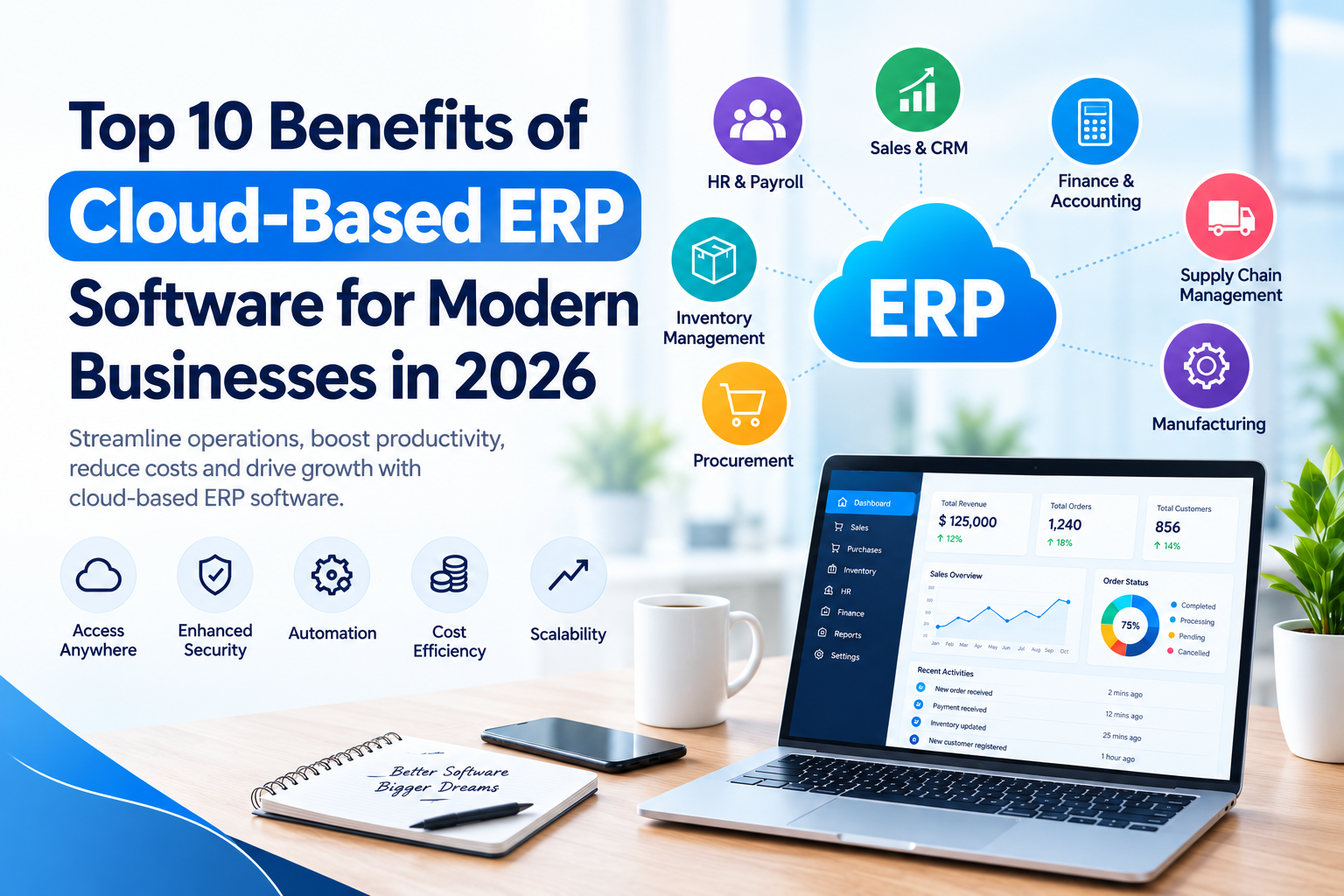
A cloud ERP system integrates multiple business functions into one platform, including:
- Finance & Accounting
- Inventory Management
- Sales & CRM
- Procurement
- Human Resource Management (HRMS)
- Payroll
- Manufacturing
- Supply Chain Management
- Reporting & Analytics
Because all departments work from a single database, businesses gain better visibility, improve efficiency, and reduce manual work.
Top 10 Benefits of Cloud-Based ERP Software
1. Access Your Business Anytime, Anywhere
One of the biggest advantages of Cloud-Based ERP Software is remote accessibility.
Employees and business owners can securely access business data from:
- Office
- Home
- Client locations
- Mobile devices
- Any location with internet access
This flexibility supports remote work, hybrid teams, and multi-location businesses while ensuring uninterrupted operations.
2. Lower IT Infrastructure Costs
Traditional ERP systems require expensive investments in:
- Physical servers
- Hardware maintenance
- Data centers
- Software installation
- IT support
Cloud ERP eliminates these costs because the software is hosted and maintained by the cloud provider.
Businesses save money on:
- Hardware purchases
- Server maintenance
- System upgrades
- Backup infrastructure
- IT management
This makes cloud ERP a cost-effective solution for businesses of all sizes.
3. Automatic Software Updates
Keeping business software updated is essential for security and performance.
With Cloud-Based ERP Software:
- New features are added automatically
- Security patches are installed regularly
- Performance improvements happen in the background
- Businesses always use the latest version
There is no need for manual installations or costly upgrade projects.
4. Improved Business Collaboration
Cloud ERP connects every department through one centralized platform.
Departments such as:
- Sales
- Marketing
- Finance
- HR
- Procurement
- Customer Support
can access real-time information, reducing communication gaps and duplicate work.
Teams collaborate more efficiently because everyone works with the same data.
5. Real-Time Reporting & Analytics
Business leaders need accurate data to make informed decisions.
Cloud ERP provides interactive dashboards and real-time reports, including:
- Revenue analysis
- Sales performance
- Inventory levels
- Employee productivity
- Financial reports
- Customer insights
- Business growth metrics
These reports help businesses identify trends and make faster, data-driven decisions.
6. Better Data Security
Security is a top priority for every business.
Cloud ERP solutions include advanced security features such as:
- Role-based user access
- Multi-factor authentication
- Data encryption
- Automatic backups
- Disaster recovery
- Activity logs
- Secure cloud hosting
These features help protect sensitive business information from unauthorized access and cyber threats.
7. Easy Scalability
As your business grows, your ERP system should grow with it.
Cloud-Based ERP Software allows businesses to:
- Add new users
- Expand to multiple branches
- Introduce new modules
- Support additional departments
- Handle increased workloads
without investing in new infrastructure.
This flexibility makes cloud ERP a future-ready solution.
8. Seamless Third-Party Integrations
Modern businesses use multiple software applications.
Cloud ERP integrates easily with:
- CRM Systems
- Accounting Software
- Payment Gateways
- WhatsApp API
- Email Marketing Tools
- Inventory Software
- HRMS
- E-commerce Platforms
- Mobile Applications
This creates one connected business ecosystem, improving efficiency and reducing manual data entry.
9. Increased Productivity Through Automation
Cloud ERP automates many repetitive business processes, such as:
- Invoice generation
- Purchase approvals
- Inventory updates
- Payroll processing
- Leave management
- Sales follow-ups
- Financial reporting
Automation reduces manual work, minimizes errors, and allows employees to focus on strategic tasks.
10. Higher Return on Investment (ROI)
Although implementing ERP requires an initial investment, businesses achieve significant long-term savings through:
- Lower operational costs
- Improved productivity
- Better inventory management
- Faster business processes
- Reduced paperwork
- Better customer service
- Increased profitability
Cloud ERP delivers a strong return on investment by helping businesses operate more efficiently and scale with confidence.
Key Features of Cloud-Based ERP Software
A modern cloud ERP system typically includes:
- Financial Management
- Inventory Management
- Sales & CRM Integration
- Human Resource Management (HRM)
- Payroll Management
- Procurement & Purchasing
- Supply Chain Management
- Project Management
- Customer Support
- Business Intelligence & Analytics
- Mobile Accessibility
- Third-Party Integrations
Which Businesses Need Cloud ERP Software?
Cloud ERP Software is suitable for businesses of all sizes, including:
- Manufacturing Companies
- Retail Businesses
- E-commerce Stores
- Healthcare Organizations
- Educational Institutions
- Logistics & Transportation Companies
- Construction Firms
- Financial Services
- IT Companies
- Marketing Agencies
- Wholesale & Distribution Businesses
Whether you’re a startup or an enterprise, cloud ERP can streamline operations and improve efficiency.
Why Choose Cloud-Based ERP Instead of Traditional ERP?
Traditional ERP systems require expensive servers, regular maintenance, and dedicated IT infrastructure.
Cloud ERP offers several advantages:
- Lower implementation cost
- Faster deployment
- Automatic software updates
- Easy remote access
- Better scalability
- Higher security
- Reduced IT maintenance
- Faster business operations
These benefits make Cloud ERP Software the preferred choice for businesses in 2026.
Why Choose Glitch Probe Infotech for Cloud ERP Development?
At Glitch Probe Infotech, we develop secure, scalable, and customized Cloud ERP solutions tailored to your business requirements.
Our ERP development services include:
- Custom ERP Development
- Cloud ERP Solutions
- ERP Migration Services
- CRM & ERP Integration
- Inventory Management Systems
- HR & Payroll Modules
- Finance & Accounting Solutions
- Business Intelligence Dashboards
- Mobile ERP Applications
- Third-Party API Integration
- ERP Maintenance & Support
Our team focuses on delivering high-performance ERP systems that help businesses automate operations, improve productivity, and accelerate growth.
Conclusion
Cloud-Based ERP Software has become one of the most valuable business technologies in 2026. It centralizes business operations, improves collaboration, reduces operational costs, and provides real-time visibility into every department.
Whether you’re managing finance, inventory, HR, sales, or customer relationships, a cloud ERP system helps your business operate more efficiently and make smarter decisions.
If you’re looking for a reliable Cloud ERP Software Development Company, Glitch Probe Infotech offers customized cloud ERP solutions designed to support your business growth today and in the future.
FAQs
1. What is Cloud-Based ERP Software?
Cloud-Based ERP Software is an enterprise resource planning system hosted on cloud servers that allows businesses to manage operations online from anywhere.
2. Is Cloud ERP better than Traditional ERP?
Yes. Cloud ERP offers lower costs, automatic updates, remote accessibility, improved security, and easier scalability compared to traditional on-premises ERP systems.
3. Which businesses should use Cloud ERP?
Manufacturing, retail, healthcare, education, logistics, finance, IT companies, and businesses of all sizes can benefit from Cloud ERP.
4. Can Cloud ERP integrate with CRM and other software?
Yes. Modern Cloud ERP solutions integrate with CRM software, accounting tools, payment gateways, HR systems, inventory management, and third-party applications.
5. What are the biggest benefits of Cloud ERP Software?
The biggest benefits include lower costs, real-time reporting, remote accessibility, better collaboration, improved security, workflow automation, scalability, and increased productivity.