Customer Relationship Management (CRM) software has become an essential tool for businesses of all sizes. It helps manage customer interactions, improve sales processes, and streamline daily operations. However, one common question businesses face is whether to choose a Custom CRM or a Ready-Made CRM.
Both options have their own advantages, but the right choice depends on your business goals, budget, and future growth plans.
In this guide, we’ll compare Custom CRM vs Ready-Made CRM to help you make the right decision.
What is a Ready-Made CRM?
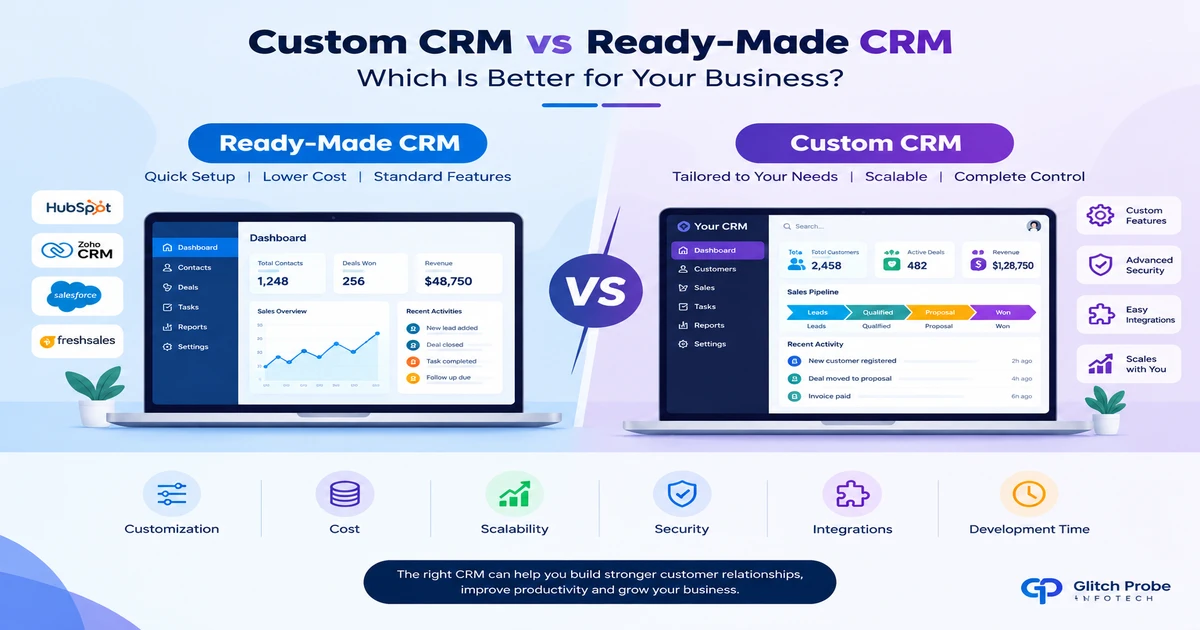
A Ready-Made CRM is a pre-built software solution designed for general business use. It comes with standard features such as:
- Contact Management
- Sales Pipeline
- Email Integration
- Reports & Analytics
- Task Management
Popular examples include HubSpot CRM, Zoho CRM, Salesforce, and Freshsales.
Advantages
- Quick setup
- Lower initial cost
- Regular software updates
- No development time
- Suitable for small businesses
Limitations
- Limited customization
- Monthly subscription costs
- Features you don’t need
- Scalability limitations
- Integration restrictions
What is a Custom CRM?
A Custom CRM is built specifically for your business. Every feature, workflow, dashboard, and integration is designed according to your business requirements.
Instead of changing your business to fit the software, the software is built to fit your business.
Advantages of Custom CRM
1. Built Around Your Business
Every business operates differently. A custom CRM matches your exact workflow.
2. Better Scalability
As your business grows, new modules and features can be added without changing the entire system.
3. Higher Security
Your customer data stays under your control with advanced security measures and role-based access.
4. Third-Party Integrations
Custom CRM can integrate with:
- ERP Systems
- Payment Gateways
- WhatsApp API
- Email Marketing Tools
- HRMS
- Inventory Software
- Accounting Software
5. Better Productivity
Employees spend less time on repetitive tasks because the CRM automates business processes.
Custom CRM vs Ready-Made CRM Comparison
| Feature | Custom CRM | Ready-Made CRM |
|---|---|---|
| Customization | ⭐⭐⭐⭐⭐ | ⭐⭐ |
| Initial Cost | Higher | Lower |
| Monthly Fees | No recurring license (depends on hosting/support) | Monthly/Annual Subscription |
| Scalability | Excellent | Moderate |
| Security | High | Shared Platform |
| Integrations | Unlimited | Limited |
| Development Time | Yes | Immediate |
| Business Fit | Perfect | Generic |
Which Businesses Should Choose a Ready-Made CRM?
A Ready-Made CRM is suitable if you:
- Have a limited budget
- Need a CRM immediately
- Run a small business
- Require only standard CRM features
Which Businesses Should Choose a Custom CRM?
A Custom CRM is ideal if you:
- Have unique business workflows
- Need custom dashboards
- Want complete control over data
- Plan long-term business growth
- Need multiple software integrations
Cost Comparison
Although a Ready-Made CRM appears less expensive initially, recurring subscription costs can become significant over time.
A Custom CRM requires a higher upfront investment, but it can reduce long-term licensing costs while offering greater flexibility and control.
Final Thoughts
Both Custom CRM and Ready-Made CRM have their advantages. If your business only needs basic CRM features, a Ready-Made CRM can be a practical starting point. However, if you need a solution tailored to your business processes, better scalability, stronger security, and seamless integrations, investing in a Custom CRM is often the better long-term choice.
Choosing the right CRM today can improve productivity, strengthen customer relationships, and support sustainable business growth.
Frequently Asked Questions (FAQs)
1. Is a Custom CRM better than a Ready-Made CRM?
A Custom CRM is better for businesses with unique workflows, while a Ready-Made CRM works well for standard business needs.
2. Is a Custom CRM expensive?
The initial investment is higher, but it can reduce recurring licensing costs over time.
3. Can a Custom CRM integrate with existing software?
Yes. It can integrate with ERP, HRMS, accounting software, payment gateways, WhatsApp APIs, and many other business tools.
4. Which CRM is best for growing businesses?
Businesses planning long-term growth generally benefit more from a Custom CRM because it can scale with their evolving requirements.
5. How do I choose the right CRM?
Consider your business size, budget, required features, integration needs, and future growth plans before making a decision.